
Memorial Products · 31 October 2026
Buying wooden pet memorial urns: A Trade Comparison
Pet memorial products require more than attractive timber and a personalized nameplate. This buying guide compares materials, construction and sourcing models to help trade buyers build reliable, sensitively presented ranges.
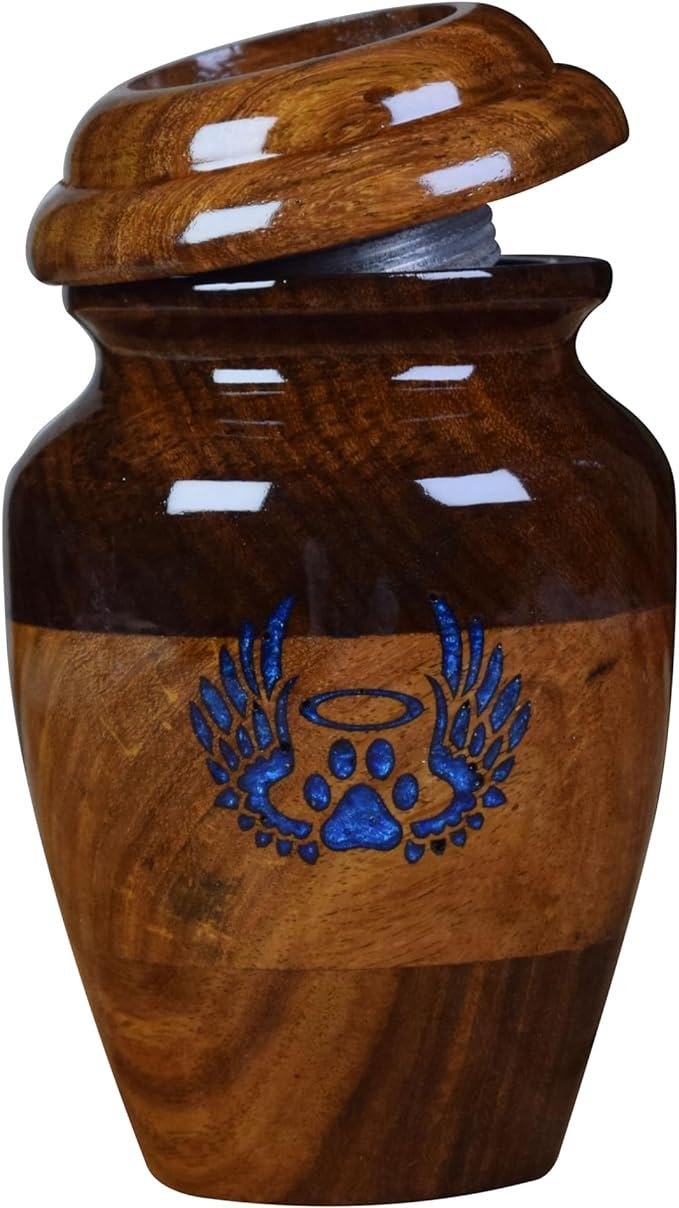
A memorial box can look right in a showroom and still fail its most important purpose. For buyers sourcing wooden pet memorial urns, the real comparison is not simply mango versus sheesham, or handmade versus factory-produced: it is whether the product safely accommodates its intended contents, arrives undamaged and supports a sensitive customer experience.
Retailers, importers and private-label brands should distinguish between containers for cremated remains and boxes for collars, photographs or other mementos. Their appearance may overlap, but their functional requirements do not. This guide compares the choices that matter before a purchase order is signed.
1. Compare wooden pet memorial urns by function first
An urn needs a defined internal capacity and a secure closure. A keepsake box needs accessible storage and a layout suited to objects. A combination product must deliver both without allowing routine access to disturb the compartment holding cremated remains.
| Product format | Best suited to | Main buying risk |
|---|---|---|
| Full-capacity pet urn | Holding the pet’s cremated remains | Capacity stated from exterior dimensions |
| Small keepsake urn | Holding a portion of cremated remains | Being mistaken for a full-capacity urn |
| Memorial keepsake box | Collars, tags, photographs and notes | Implying suitability for loose cremated remains |
| Combination memorial box | Separate storage for remains and mementos | Shared access or poorly isolated compartments |
Start with the intended use, then choose the silhouette. A narrow decorative opening can make transferring a bag difficult even when the cavity has adequate volume. An internal shelf or photo-panel assembly may also reduce usable space.
Require capacity in cubic inches and millilitres, specifying whether the measurement describes the empty cavity or practical space available with the supplied liner. Any pet-weight sizing chart should be treated as approximate and checked with cremation-service partners; cremated-remains volume varies with the animal and the cremation process.
When comparing wooden urn formats and construction options, request an internal drawing alongside the exterior photograph. This is more useful for range planning than a size label such as “medium.”
2. Compare timber character against production consistency
Species selection affects appearance, engraving contrast, machining and cost. However, a prestigious timber name does not compensate for inadequate drying or poor joinery. Ask for botanical identification where relevant, documented sourcing and a clearly agreed construction specification.
Mango: character-led and suitable for varied finishes. Mango can offer pronounced variation in grain and colour, making it attractive for warmer, craft-oriented collections. That variation also creates challenges when retailers expect a uniformly pale or evenly stained range. Approve an acceptable range of appearances rather than a single unusually clean sample.
Sheesham: distinctive grain with a darker presentation. Its visual movement can suit substantial, traditional memorial designs. Natural contrast may compete with fine engraving, particularly on small name panels. Check legibility on several boards, and verify the exact species and destination-market documentation requirements rather than relying on the commercial name alone.
Teak: a restrained premium positioning. Teak may suit a higher-priced range, but buyers should not assume outdoor-use associations make every teak memorial product appropriate for a garden. The completed assembly, hardware, adhesive and finish determine suitability. Bonding and coating performance also need checking on the supplier’s actual production process.
Veneered engineered construction: a separate commercial proposition. A well-made veneered box can offer consistent surfaces and dimensional stability. It should be described accurately, not sold as solid wood. Buyers must assess exposed edges, screw retention, moisture vulnerability and any applicable composite-wood emissions requirements.
For premium wooden accessories, select timber according to the desired appearance and service conditions, not a simplistic species hierarchy. Where carving or engraving is central, compare finished samples of the actual design across the shortlisted materials.
3. Compare closures, finishes and personalization systems
The most attractive exterior is not necessarily the easiest product to fill, close or personalize. For wooden pet memorial urns, prioritize predictable handling over decorative complexity.
A screw-fastened base provides deliberate access and can keep hardware out of view. Its performance depends on panel fit, fixing quality and resistance to thread damage. A sliding panel may be simpler to operate, but seasonal wood movement can make it loose or difficult to remove. A hinged lid is convenient for keepsakes; a magnetic catch alone should not be assumed sufficient to secure a compartment containing cremated remains.
Agree whether the product requires a sealed inner bag or another liner. Do not describe an ordinary wooden box as airtight or watertight without appropriate evidence. Likewise, avoid promising suitability for burial or outdoor display unless the complete product has been assessed for that use.
Personalization introduces another comparison:
- Direct engraving integrates the inscription into the timber, but natural grain can affect contrast and a spelling error may scrap the finished piece.
- Separate engraved plates allow later personalization and easier replacement, but attachment quality and alignment become critical.
- Photo windows offer a familiar memorial feature, but require secure backing, safe edges and a clear image-size specification.
The distinction between full-capacity products and keepsake formats should also carry through to listings and instructions; a broader guide to cremation and pet urns can help buyers organize that terminology.
Request fully cured finish samples and check for persistent odour, tackiness, colour transfer and rough internal surfaces. Keep claims about safety, sustainability or finish performance specific and supported.
4. Compare stock buying, modified designs and full OEM
Sourcing models often have a greater effect on launch risk than small differences in unit price. Buyers expanding an existing wholesale wooden accessories assortment may be best served by stock shapes; specialist memorial brands may need deeper control.
Stock designs generally reduce development work and make initial evaluation straightforward. Their disadvantages are limited differentiation and possible overlap with competitors. Confirm whether the offered design is genuinely stocked or only made after order placement.
Modified existing designs offer a middle route: an established box with a different finish, plate, photo insert or branded package. However, changes are not always superficial. A larger inscription panel or added compartment can affect construction, capacity and packing dimensions.
Full OEM development allows control over proportions, access systems and compartment layouts. It also requires drawings, prototype approval and explicit responsibility for tooling, revisions and design ownership. Searching for an “OEM wooden products manufacturer India” can identify prospects, but capability should be judged through samples and documented processes rather than search visibility.
Nagina, in Bijnor district, Uttar Pradesh, is one sourcing location to consider. Exporters there include Woodzire, a wooden handicraft maker since 1990 offering urns and OEM/private-label production. As with any candidate, establish which operations are performed in-house and which are subcontracted.
When evaluating OEM and private-label wooden products, request minimum quantities by design, size and finish—not just a headline order minimum. Also clarify repeat-order lead times, replacement-component availability and whether personalization occurs before export or closer to the final customer.
Local engraving can reduce finished personalized inventory, while origin engraving may simplify fulfilment for standardized orders. Compare the entire workflow, including proof approval and error correction.
5. Compare landed cost and acceptance evidence
A lower ex-factory price can become expensive if products arrive scratched, closures bind or packaging needs replacement. Compare suppliers against the same written specification and delivery terms, including freight, duties, inspection, personalization and protective packaging.
For wooden pet memorial urns, establish an acceptance checklist covering:
- Usable capacity: confirm dimensions and check fit with the intended liner or bag.
- Closure operation: test opening, refastening and panel alignment on production samples.
- Visual tolerances: define acceptable grain variation, knots, colour differences and engraving contrast.
- Hardware and interiors: inspect for protruding screws, sharp edges, splinters and loose components.
- Packing performance: assess corner protection, surface abrasion and hardware movement through the intended shipping route.
The appropriate export packaging for wooden products depends on whether cartons travel by pallet, parcel network or both. Ask for a packing specification and suitable transit-test evidence, rather than accepting “export quality” as a measurable standard.
Separate retail presentation from transport protection. An attractive gift box may still need an outer shipping carton. Any solid-wood transport packaging should meet applicable phytosanitary requirements; those requirements are distinct from rules governing the finished product.
Inspect production units as well as approved samples. Record defects consistently so repeat orders can be compared with the same benchmark. For personalized goods, retain approved artwork and define who pays for corrections when the delivered inscription differs from that approval.
6. Key takeaways
A focused launch range is usually easier to control than a broad catalogue with overlapping sizes and unclear functions. Start with distinct use cases, establish reliable production, then expand materials and decorative options.
- Separate full-capacity urns, small keepsake urns and memento boxes in both purchasing specifications and customer-facing descriptions.
- Compare usable internal capacity, not exterior dimensions or size names alone.
- Choose timber for appearance, engraving compatibility and production consistency; verify sourcing and applicable compliance separately.
- Match the closure to the intended use, and avoid unsupported airtight, outdoor-use or burial claims.
- Compare stock, modified and OEM models through total workflow cost, including personalization errors and replacements.
- Approve construction, finish and packaging together. A memorial product is only ready for sale when all three perform reliably.
The strongest assortment is not necessarily the most ornate. It is the one buyers can describe accurately, replenish consistently and deliver with the care the category requires.
- wooden pet memorial urns
- pet keepsake boxes
- wholesale wooden accessories
- premium wooden accessories
- OEM wooden products manufacturer India
- private-label pet urns
- wooden urn sourcing
- memorial product packaging